Where to Stay in Puglia: From Trulli Villages to the Salento Coast

Our luxury villas in Puglia range from restored masserie and clusters of trulli to aristocratic palazzi and houses with a gate onto the sea.
This guide sets out the best places to stay in Puglia by area, with travel times, beaches, food, things to do and when to go, so you can match a base to the holiday you have in mind.
How big is Puglia?
Puglia covers around 19,500km², or roughly 7,500 square miles, with more than 800km of coastline. A drive from Vieste on the Gargano to Santa Maria di Leuca at the southern tip takes around five hours, and many holidays are spent in the middle and south of the region, where Martina Franca and Lecce are roughly an hour and a half apart by car.
What is Puglia like?
Puglia's terrain is on the flatter side and has a wonderful agricultural quality. A region of olive groves, red earth, dry stone walls and towns built in pale limestone. We return to it again and again for its:
- Ancient olive groves: the plain between Ostuni and Fasano is planted with olive trees thought to be many centuries old, their trunks twisted into sculptural shapes
- Architecture found nowhere else: the conical trulli of the Valle d'Itria, fortified farmhouses known as masserie, and Lecce's baroque façades, carved from a soft local limestone.
- Two Seas: the Adriatic along the east coast and the Ionian on the western side of the Salento, so a sunrise swim and a sunset swim can happen on the same day.
- Cooking rooted in the land: orecchiette with cime di rapa, burrata from Andria, bombette grilled to order in Cisternino, and wines made from Primitivo and Negroamaro.
- Long, warm summers: June to September is typically hot and dry, with daytime temperatures often in the high 20s to low 30s°C

Polignano a Mare
The best places to stay in Puglia
Each part of Puglia suits a different kind of holiday. The areas below run roughly north to south through the central and southern parts of the region, where most of our villas sit, followed by the Gargano in the far north. All travel times are approximate and by car.
Valle d'Itria: trulli, vineyards and hilltop towns
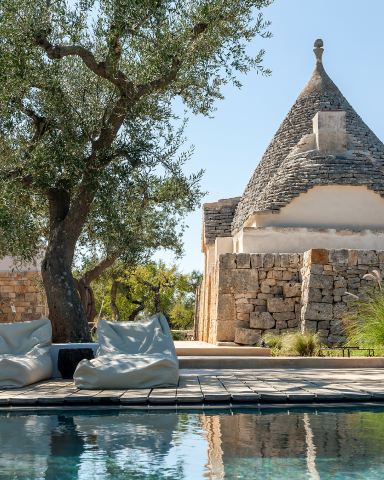
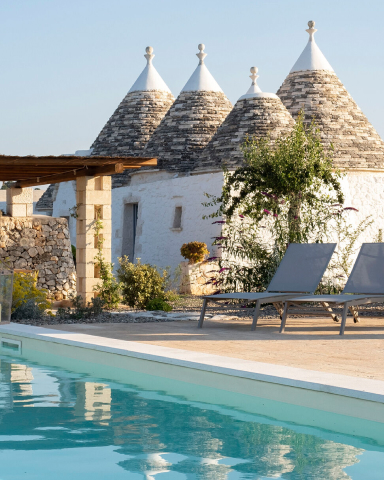
The Valle d'Itria is a shallow, fertile basin between Martina Franca, Locorotondo, Cisternino and Alberobello, where trulli stand among vineyards and almond trees and each low hill is topped by a town. Villas here tend to be restored trulli or masserie with verdant gardens and pools, surrounded by farmland, and the Adriatic lies around half an hour below the valley's edge.
Why choose the Valle d'Itria:
- A central position: the Adriatic coast, Ostuni and the valley's towns all sit within an hour, and Lecce works as a day trip.
- Trullo living: many of our trulli holidays in Puglia are in this valley, from a single restored cone to complexes of eight or more.
- Food and wine: Locorotondo's crisp whites, capocollo from Martina Franca and the fornelli pronti of Cisternino, where butchers grill meat for diners at street tables.
- Fresh evenings: the valley sits a few hundred metres above sea level, so summer nights tend to be cooler than on the coast.
Best For: first-time visitors, couples, food and wine lovers, families who want countryside space with the coast a half-hour drive away.
Travel times from Martina Franca (by car):
- Bari Airport (BRI): 60 to 75 minutes
- Brindisi Airport (BDS): 50 to 60 minutes
- Alberobello: 15 to 30 minutes
- Ostuni: 30 to 40 minutes
- Monopoli: 35 to 45 minutes

Ostuni and the olive plain: the White City above the sea
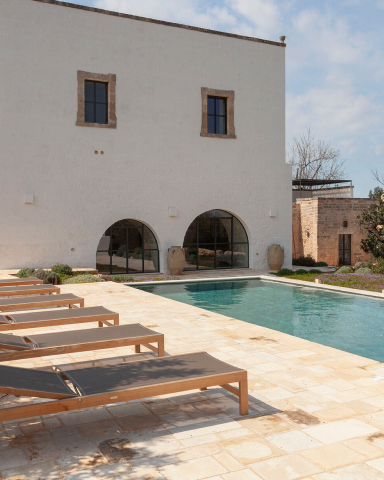
Ostuni's old town climbs its hill in a tangle of whitewashed lanes, stairways and arches, crowned by a late-Gothic cathedral. Below, the plain runs down to the Adriatic through groves of ancient olives, with masserie scattered among them and the Torre Guaceto nature reserve on the coast to the north.
Why choose Ostuni:
- Town and coast together: the old town's restaurants are a short drive from villas set among the olives, and the beaches near Ostuni at Torre Guaceto and Rosa Marina are close by.
- Masseria country: many of the region's fortified farmhouses stand on this plain; our guide to masserie in Puglia traces their history.
- Lively evenings: the piazza and lanes of Ostuni stay animated late into summer nights.
- Close to Brindisi: Brindisi Airport (BDS) is under an hour away, useful for late arrivals.
Best for: couples, groups of friends, travellers who want a lively town nearby and a countryside villa to return to
Travel times from Ostuni (by car):
- Brindisi Airport (BDS): 35 to 45 minutes
- Bari Airport (BRI): 60 to 75 minutes
- Cisternino: 20 to 25 minutes
- Alberobello: 35 to 45 minutes
- Lecce: 50 to 60 minutes


Monopoli and Polignano a Mare: harbour towns on the Adriatic
South of Bari, the coast is a run of low limestone cliffs, rocky inlets and fishing towns. Monopoli is a working port with a walled old town, a castle on the harbour and small town beaches. Polignano a Mare, a few minutes north, stands on cliffs above the sea, with caves cut into the rock beneath its old centre.
Why choose Monopoli and Polignano a Mare:
- Swimming on foot: small coves and town beaches sit within walking distance of the old centres.
- Rail links: both towns are on the Adriatic line between Bari and Lecce, useful for days out without a car.
- Seafood: the fishing boats in Monopoli's harbour supply the trattorie a few steps away.
- Valley and coast: the trulli of Alberobello are around half an hour inland.
Best for: families, beach-first travellers, guests relying on trains, those who like to walk from the villa into a harbour town.
Travel times from Monopoli (by car):
- Bari Airport (BRI): 45 to 55 minutes
- Brindisi Airport (BDS): 55 to 65 minutes
- Polignano a Mare: 10 to 15 minutes
- Alberobello: 30 to 35 minutes
- Ostuni: 30 to 35 minutes
Many of our villas near Bari sit in the countryside behind Monopoli and Polignano, close enough to the coast for a morning swim and a lunch by the harbour.


Lecce: baroque streets at the heart of the Salento
Lecce: The Florence of the South
Lecce's historic centre is a showcase of the Leccese baroque: church fronts, balconies and palazzi carved from pietra leccese, a limestone soft enough to work into fine detail. A Roman amphitheatre lies half-excavated below Piazza Sant'Oronzo. Our villas around the city are in the countryside and the small baroque towns nearby, such as Galatina.
Why choose Lecce:
- Culture on the doorstep: the Basilica di Santa Croce, the cathedral square and the amphitheatre are all within a short walk of one another.
- Two coasts in an hour: Adriatic beaches lie around 20 to 30 minutes east, the Ionian shore around 40 to 50 minutes west.
- Salento food: pasticciotto for breakfast, rustico at lunch and caffè leccese, espresso over ice with almond milk, in the afternoon.
- A Hub for the Salento: roads and trains fan out from Lecce across the peninsula.
Best for: culture lovers, architecture enthusiasts, food lovers, guests combining city days with the beaches of both coasts
Travel times from Lecce (by car):
- Brindisi Airport (BDS): 35 to 40 minutes
- Otranto: 40 to 50 minutes
- Gallipoli: 40 to 50 minutes
- Santa Maria di Leuca: 60 to 75 minutes
Our luxury villas in Salento include a number of villas near Lecce, from town palazzi to country houses. For more ideas on bases nearby, see our guide to the best towns in Salento.


Gallipoli and the Ionian coast: sandy shores and western sunsets
Gallipoli's old town stands on a limestone island joined to the mainland by a bridge, its walls wrapped around fishermen's houses, baroque churches and a castle. The Ionian shore either side has long sandy beaches backed by dunes and pine woods, and the sun sets over the sea.
Why choose Gallipoli and the Ionian coast:
- Sand underfoot: the Purità beach sits below the old town walls, with longer stretches at Baia Verde and Punta della Suina to the south.
- The morning catch: raw prawns and sea urchins are served at the harbour, and the fish market is busy from early morning.
- Sunsets over the water: the west-facing coast makes the evening aperitivo the main event.
- A summer buzz: August is the liveliest month, when Italian families arrive for the Ferragosto holiday.
Best For: beach holidays, families with young children who prefer sand, seafood lovers, groups who want evening energy in town
Travel times from Gallipoli (by car):
- Brindisi Airport (BDS): 70 to 80 minutes
- Lecce: 40 to 50 minutes
- Santa Maria di Leuca: 45 to 55 minutes
- Otranto: 50 to 60 minutes

Gallipoli
Otranto and the southern Salento: cliffs, coves and the tip of the heel
Otranto, the easternmost town in Italy, gathers its old quarter behind Aragonese walls, and the floor of its cathedral holds a vast 12th-century mosaic of the Tree of Life. South from here, the coast road to Santa Maria di Leuca follows limestone cliffs above sea caves, rock pools and small harbours such as Castro and Tricase Porto, ending at the lighthouse where the Adriatic meets the Ionian.
Why choose the southern Salento:
- Clear water: Baia dei Turchi north of Otranto, the Grotta della Poesia at Roca and the sea caves of Castro are among the region's best-known swimming spots.
- Days on the water: private boat charters in Salento follow the cliffs into caves that are inaccessible from land.
- Village life: inland towns such as Specchia and Tricase keep their own rhythm of markets and evening walks.
- Space: villas here often sit alone on the coast or in their own olive groves.
Best for: couples, keen swimmers and snorkellers, families who want the sea at the end of the garden, longer villa stays
Travel times from Otranto (by car):
- Brindisi Airport (BDS): 60 to 75 minutes
- Lecce: 40 to 50 minutes
- Castro: 25 to 30 minutes
- Santa Maria di Leuca: 50 to 60 minutes

The Gargano peninsula: forest and limestone in the north
Puglia's northern spur rises into the beech woods of the Foresta Umbra and drops to white cliffs, sea stacks and sandy bays around Vieste and Peschici. Boats run from the coast to the Tremiti Islands, and fishing platforms called trabucchi still stand on stilts above the water.
Why choose the Gargano:
- Woodland walking: shaded trails through the Foresta Umbra, part of the Gargano National Park.
- Caves by boat: excursions from Vieste follow the cliffs into sea caves and arches.
- The Tremiti Islands: a day trip by sea to a small archipelago of clear water and pine-topped rock.
Best for: walkers and nature lovers, travellers combining Puglia with a longer Italian road trip
Vieste is around two and a half hours by road from Bari Airport (BRI), so the Gargano suits a dedicated stay of its own
The best villas in Puglia by style
The best villas in Puglia draw on the region's building traditions, and the style you choose shapes a stay as much as its location.
Impeccable masserie
Fortified farmhouses, many dating from the 16th to 18th centuries, built around courtyards with thick walls, watchtowers and olive groves. Their scale suits large groups and multi-generation families. Browse our masserie in Italy.
Characterful trulli
Dry stone cones built without mortar, now restored as homes that link several cones around a pool and garden, mostly in the Valle d'Itria. Our guide to trulli houses explains how they were built.
Grand palazzi and historic houses
Town palaces and aristocratic country houses in the Salento, with star-vaulted ceilings, frescoes and walled gardens. See our palaces for rent in Italy.
Scenic seafront properties
Houses a short walk from the water, from the cliffs south of Otranto to the coves around Monopoli. Browse our seafront villas in Puglia.
Large villas for families and groups
Our family villas in Puglia have space, gardens and safe swimming in mind, and every property has a private pool. Many are fully serviced, and our Villa Specialists can add daily housekeeping, private cooks and in-villa experiences.

Casino Doxi Stracca
Alezio, Puglia
14 Guests
7 Bedrooms
7 Bathrooms
- Historic manor house
- Inspiring restoration
- Extensive mature gardens
- 18m-long pool
- Plunge pool
- Space aplenty
- Versatile accommodation
Planning your Puglia stay: practical considerations
How many bases do you need?
A week from one base covers a good half of the region. With ten days to two weeks, many guests split their stay between the Valle d'Itria or Ostuni and the Salento, pairing countryside with coast.
Two weeks plus: three bases allow you to experience Puglia's diversity, perhaps Valle d'Itria, Salento, and either Matera or the Gargano Peninsula.
Do you need a car?
For countryside villas, yes. A car makes a real difference in the Valle d'Itria and the southern Salento. Lecce, Monopoli, Polignano a Mare and Ostuni are linked by train, though Ostuni's station sits outside the town.
When's best to visit Puglia?
Peak season (July-August): Warmest weather, liveliest atmosphere, highest prices. Beaches and popular towns get crowded, especially around Ferragosto (15 August). Book well in advance.
Shoulder season (May-June, September-October): Ideal timing. Warm weather, swimmable seas, fewer crowds, better availability. Many consider these the best months for Puglia.
Spring (April-early May): lush countryside, wildflowers, pleasant temperatures for sightseeing. Some coastal facilities may not yet be open.
Off-season (November-March): Many coastal establishments close. Focus on cities like Bari, Lecce, and Taranto that maintain year-round life, or visit around Christmas for festive atmosphere.

Alberobello
Beyond accommodation: making the most of your stay
Must-try experiences
Valle d'Itria:
- Walk Alberobello's UNESCO-listed trulli district
- Wander Locorotondo's circular old town
- Savour bombette at Cisternino's fornelli pronti (butcher-restaurants)
- Admire Ostuni's white labyrinth
- Discover Martina Franca's baroque palazzi
Salento:
- Marvel at Lecce's baroque architecture, especially Basilica di Santa Croce
- Sample pasticciotto and rustico leccese
- Visit Otranto's cathedral with its stunning medieval floor mosaic
- Drive the dramatic coastal road from Otranto to Santa Maria di Leuca
- Swim in the turquoise waters of Baia dei Turchi or Pescoluse
Coast:
- Photograph Polignano a Mare's iconic clifftop setting
- Watch the boats come in at Monopoli's working fishing harbour
- Swim or walk the Torre Guaceto nature reserve
- Enjoy aperitivos watching Gallipoli's Ionian sunsets
Beyond Puglia:
- Stay overnight in Matera's sassi cave dwellings (absolutely worth it)
- Visit Castel del Monte, Frederick II's octagonal fortress
Seasonal considerations
Summer visitors should embrace the Italian holiday rhythm; long lunches under the sun, evening passeggiata, late dinners. Many businesses close for several hours in the afternoon.
Shoulder season travellers enjoy more flexibility, better availability at top restaurants, and locals with more time to chat.
Off-season visitors should verify opening hours, as many restaurants and attractions close or reduce hours significantly from November through March.
Find your villa in Puglia
Our Villa Specialists know each of our villas in Puglia first-hand, from the trullo that suits a honeymoon to the masseria built for three generations. Tell them who is travelling and what you want from the week, and they will draw up a shortlist from our 300+ luxury villas, then arrange transfers, car hire, private cooks and experiences around it.


Frequently Asked Questions
What is the best area to stay in Puglia for first-time visitors?
When deciding where to stay in Puglia for a first visit, every area works; the right base depends on what you want from your days. The Valle d'Itria and Ostuni put trulli, hilltop towns and Adriatic beaches close together. Lecce and the Salento pair baroque towns with two coastlines.
How many days do you need in Puglia?
A week from one base covers a good half of the region. With ten days to two weeks, many guests split their stay between the Valle d'Itria or Ostuni and the Salento, pairing countryside with coast.
What's the best way to get to Puglia?
You can get to Puglia by flying into Bari Karol Wojtyła Airport (BRI) or Brindisi Airport (BDS), both with direct flights from across Europe in summer, or by train from Rome and northern Italy.
Can you stay in Puglia without a car?
Yes, though with limitations. Basing yourself in well-connected towns on the main Adriatic railway line; Bari, Polignano a Mare, Monopoli, Ostuni, Brindisi, and Lecce, makes car-free travel feasible. However, a car significantly enhances your experience, particularly for accessing countryside villas, hilltop towns in the Valle d'Itria, remote beaches, and Salento's interior. Public transport connections exist but can be infrequent and time-consuming.
What are the best places to stay in Puglia for beaches?
For sand, look to Gallipoli and the Ionian coast of the Salento. For clear water and rocky swimming, try Otranto, Castro and the southern Salento. For coves within walking distance of town, Monopoli and Polignano a Mare.
Which are the best villas in Puglia for large groups?
Masserie and large trulli complexes have the space for big groups, and several of our villas sleep 14 or more. See our villas for large groups, or ask a Villa Specialist for a shortlist.


We're Villa Matchmakers
Because our local experts have personally visited each of our destinations, we know exactly what makes them special. Tell us what your ultimate villa holiday looks like, and allow us take care of the rest.